
How to Get a Toddler Excited to Use the Potty: 7 Steps That Work
Struggling to get your toddler excited about the potty? These 7 practical steps turn reluctance into enthusiasm, no pressure or prizes required.
You’ve read all the guides. Your toddler checks the readiness boxes. But when you suggest the potty, you get a hard “no” or complete indifference. The problem isn’t usually skill or timing. It’s interest. And fortunately, interest can be built.
Here’s how to get a toddler excited to use the potty, step by step, without resorting to pressure or endless negotiations.
Step 1: Start with bathroom exposure, not bathroom expectations
Long before your child sits on the potty for real, make the bathroom a familiar, boring, everyday place. According to Mayo Clinic, teaching bathroom basics should start months before actual potty training begins. By 18 months, you can use simple words like “pee,” “poop,” and “potty” in casual conversation. Point out the toilet. Explain what it’s for. Let your toddler come with you.
Place a potty chair wherever your child spends the most time, not necessarily in the bathroom right away. Let them sit on it fully clothed, put stickers on it, or give it a name. The American Academy of Pediatrics recommends letting toddlers play with the potty chair for a few days before using it, which removes the mystery and the pressure.
The goal here isn’t performance. It’s comfort.
Step 2: Give them control over the gear
Toddlers love autonomy, and potty training is full of opportunities to give it to them. Let your child pick their own potty seat, step stool, or underwear. UC Davis Health suggests choosing potty gear that makes the process easy and fun, including letting toddlers select the color or design.
Underwear with favorite characters can be surprisingly motivating. So can a potty seat shaped like a throne or one with handles they can grip. When kids feel ownership over the tools, they’re more likely to want to use them.
If your toddler shows interest in “big kid” underwear but isn’t quite ready, let them wear it over a pull-up for a while. It’s a bridge, not a compromise.
Step 3: Turn aiming into a game
For toddlers (especially boys learning to aim), the potty can feel abstract and boring. Adding a visual target makes it concrete and fun. As we cover in our guide on toilet targets for potty training, anything that fizzes, floats, or changes color turns aiming into instant feedback.
This is where Potty Pirates comes in naturally. These small pirate-ship tablets drop into the toilet bowl and respond when your child aims: they fizz, swirl with color, and dissolve as they clean the bowl. For a toddler, that’s not a chore. That’s a science experiment. The tactile, visual reward keeps them coming back without requiring you to hand out candy every five minutes.
You can also try cereal loops, ice cubes, or washable paint dots. The key is novelty and immediate cause-and-effect. If you’re looking for more low-prep ideas, check out our list of potty training games for toddlers.
Step 4: Use pretend play to normalize the process
Let your toddler “teach” a doll or stuffed animal how to use the potty. Mayo Clinic specifically recommends this strategy as part of readiness preparation. When kids play the teacher role, they process what’s expected of them in a low-stakes way.
You can narrate: “Oh, Bear has to go potty! Can you help him sit down? Good job! Now we wait. Uh oh, I think he went! Let’s clap for Bear.” This kind of play rehearses the whole routine (sitting, waiting, celebrating) without any pressure on your child to perform.
Bonus: it also lets you troubleshoot fears. If your toddler is nervous about flushing or falling in, the stuffed animal can “feel scared” too, and you can talk through it together. For kids dealing with toilet anxiety, our post on toddlers afraid of the toilet has more targeted strategies.
Step 5: Build a simple, repeating routine (not a rigid schedule)
Toddlers thrive on predictability, but they resist being bossed around. Create a loose rhythm instead of a timer. Suggest the potty at natural transition points: after waking up, before leaving the house, after meals, before bath time.
Use the same language every time. “Let’s try the potty before we go outside.” Not “Do you need to go?” (The answer will always be no.) Keep the tone light and matter-of-fact, like brushing teeth or washing hands.
If they don’t go, that’s fine. The goal is to make visiting the potty a normal part of the day, not a test. UC Davis Health emphasizes that parents should never force a child to sit on the toilet, and if nothing happens after a minute or two, it’s time to move on without frustration.
Step 6: Celebrate effort, not just results
Praise every step in the right direction, even if your toddler sits for three seconds and hops off. “You sat on the potty! That’s awesome!” This matters more than you think. According to UC Davis Health, consistent praise is one of the most effective motivators during potty training.
Some families do a potty dance. Others ring a bell. Some let the child pick a song to sing after every try. The ritual becomes part of the fun, and it keeps the vibe positive even on days when nothing actually lands in the potty.
Avoid overloading on rewards for every single tinkle, though. As one parent shared in an online parenting forum, when toddlers start gaming the system (sitting every five minutes for another sticker), the reward loses meaning. Instead, focus on celebrating milestones: a whole morning dry, the first poop in the potty, or a full day without accidents.
For more ideas on how to structure rewards that don’t lose steam, see our guide on potty training reward ideas and alternatives to sticker charts.
Step 7: Keep it low-pressure and be ready to pause
Even with all the right strategies, some toddlers just aren’t emotionally ready yet. If every potty attempt ends in tears, defiance, or stress, it’s okay to take a break. Mayo Clinic notes that your own readiness matters too, and forcing the process when either you or your child isn’t ready usually backfires.
Sometimes stepping back for a few weeks and reintroducing the idea with fresh energy (and maybe a new approach) makes all the difference. Potty training is a developmental milestone, not a deadline.
If your child was making progress and suddenly regresses, that’s also normal. Check out our post on potty training regression for guidance on what might be happening and how to respond calmly.
When excitement still doesn’t come naturally
Some kids will never jump up and down about using the potty, and that’s okay. The goal isn’t to manufacture enthusiasm out of thin air. It’s to remove barriers (fear, boredom, control battles) and add just enough novelty and fun to tip the scales.
If your toddler fits all the readiness signs but remains totally unmotivated, you’re not alone. As one parent put it in an advice column, “I’ve yet to meet a parent who successfully and fully potty-trained with the power of stickers and M&Ms alone.” Sometimes you need to get creative, try three different tactics, and land on the weird one that clicks.
That might be a special bathroom-only book. It might be screen-free activities that keep them entertained while they sit. It might be letting them pour the fizzing tablet into the toilet themselves before they aim. Motivation is personal. Your job is to experiment until you find what works for your kid.
And if you’re stuck in a standoff with a truly stubborn toddler, our guide on potty training a stubborn toddler walks through what to do when nothing seems to be working.
The big idea: You can’t force a toddler to care about the potty, but you can make it interesting enough that they want to try. Give them control, add a little novelty, celebrate every small win, and keep the whole thing as low-pressure as possible.
Sources
Frequently asked questions
Find what genuinely excites your child, whether that's choosing their own potty seat, playing a game, or aiming at something fun in the toilet. Every toddler is motivated differently, so skip the generic sticker chart if it's not working and experiment with novelty, control, and making the bathroom less boring.
Turn the potty into a game by adding toilet targets, fizzing tablets, or color-changing surprises. Let your toddler pick out special underwear, read a bathroom-only book, or do a silly potty dance together. The goal is to make the experience interesting and playful, not transactional.
You can absolutely spark interest even if your toddler isn't begging to use the potty. Start by making the bathroom a familiar, low-pressure place they visit often. Use simple language, point out when others use the toilet, and let them play with a potty chair before expecting them to use it. Interest often follows exposure and fun.
Physical readiness doesn't guarantee emotional readiness, and that's okay. Focus on building positive associations first: let them watch you flush, pick out their potty gear, or practice with a stuffed animal. Sometimes toddlers need to feel in control of the process before they're willing to participate.
Make potty training the part of the day they ask for
- A fleet of fizzing, color-changing pirate ships
- Aim-and-dissolve target practice in every bowl
- Non-toxic formula that cleans as it plays
- The whole collectible crew to discover
We'll email you the moment we launch on Kickstarter. No charge today.
Make potty training the adventure they ask for
Reserve your spot for early access and founding-crew pricing. No payment today.
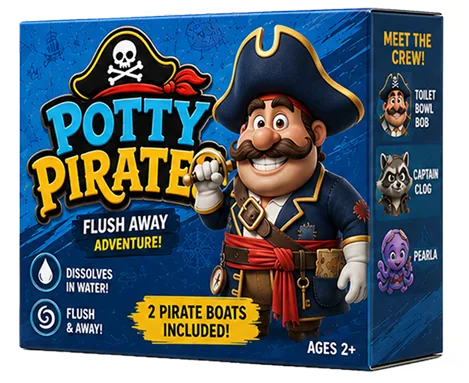
Captain Bob Edition
- A fleet of fizzing, color-changing pirate ships
- Aim-and-dissolve target practice in every bowl
- Non-toxic formula that cleans as it plays
- The whole collectible crew to discover
We'll email you the moment we launch on Kickstarter. No charge today.