
How to Potty Train a Stubborn Toddler (Without the Battles)
Your capable toddler won't use the potty? You're not alone. Here's how to decode resistance, pick the right approach, and move forward without power struggles.
You know your toddler can do this. They’ve peed on the potty before. They tell you when they’re about to go. They hide behind the couch to poop in their diaper with laser focus. But the moment you suggest the potty? Absolute refusal. Welcome to potty training a stubborn toddler, where capability and cooperation are two very different things.
You’re not failing. Your child isn’t broken. And no, they won’t go to kindergarten in diapers (though it feels that way at 3 p.m. on day five). What you’re facing is usually a mismatch between your approach and what’s driving the resistance. Let’s figure out the why, then fix it.
First: Is this stubbornness or unreadiness?
Before we troubleshoot refusal, make sure you’re not mistaking normal unreadiness for defiance.
True readiness looks like this:
- Stays dry for two or more hours at a time
- Signals when they need to go (words, gestures, or behaviors like hiding or pacing)
- Can pull pants up and down
- Shows interest in the bathroom or imitates older kids
- Follows simple two-step directions
- Can sit still for a few minutes
If your toddler isn’t checking most of these boxes, the “stubbornness” might actually be their body or brain saying “not yet.” The Mayo Clinic notes that readiness depends on developmental milestones, not age, and pushing before a child is ready often backfires.
If your child is clearly ready but refusing? Keep reading.
Want a full breakdown of readiness? Check out our potty training readiness checklist.
Why capable toddlers refuse the potty
Stubbornness is a symptom, not the cause. Here are the most common reasons a physically ready toddler digs in their heels.
They need control
Toddlers have almost no say over their daily lives. You pick their clothes, their food, their schedule. The potty? That’s one thing they can control completely, and they know it.
What it looks like: Your child might agree to sit on the potty, then hold it. Or they’ll pee the second you put a diaper back on. It’s not manipulation, it’s power.
The process feels uncomfortable or scary
Even if your child isn’t afraid of the toilet, the sensation of releasing pee or poop in an unfamiliar spot can feel weird or vulnerable. Add in a big echoey toilet, a cold seat, or a loud flush, and the discomfort multiplies.
What it looks like: Your child tenses up on the potty, says it doesn’t feel right, or only goes in a diaper when they can hide or relax in private.
If fear is the main issue, we have a dedicated guide: toddler afraid of the toilet.
The stakes feel too high
If potty training has become a daily topic of conversation, complete with countdowns, charts, and your visible frustration, your toddler feels the pressure. When the stakes are high, some kids freeze or rebel.
What it looks like: Your child was making progress, then suddenly stopped. Or they refuse even to talk about the potty.
They’re distracted or busy
Toddlers live in the moment. Stopping a game to use the bathroom requires executive function they’re still developing. For active, strong-willed kids, the potty is an annoying interruption.
What it looks like: Your child ignores their body’s signals, has accidents mid-play, or insists they don’t need to go (then immediately does).
It actually hurts
If pooping is painful, your child will avoid the potty at all costs. Constipation or a small tear can create a vicious cycle: withholding leads to harder stool, which makes the next attempt even more painful.
What it looks like: Your child holds poop for days, tiptoes, crosses legs, or only poops in a diaper while standing. You might see hard, pebble-like stool or streaks of blood.
This is covered in depth here: toddler holding poop.
How to move forward (by cause)
Once you know the why, you can pick a strategy that actually fits.
If it’s about control: Hand over the reins
Stop asking if they need to go. Stop reminding. Stop hovering. Instead, give them ownership.
Try this:
- Let them pick their own potty seat or underwear (in a store or online, their choice matters).
- Say once, calmly: “You’re in charge of your body. When you’re ready to use the potty, let me know.” Then drop it for a few days.
- Set up a potty station they can access solo: stool, wipes, a basket of books.
- If they pee on the potty, respond with calm acknowledgment, not a parade. “You did it” works better than “OH MY GOSH GOOD JOB!”
For boys learning to aim, giving them a target they control works wonders. Potty Pirates (those fizzing pirate-ship tablets that turn aiming into a game) fit perfectly here because the child is in charge of making them swirl and dissolve. It’s their show, not yours.
More ideas for aim: how to teach a boy to aim in the toilet.
If it’s discomfort or sensory: Make the potty feel safe
You need to lower the stakes and increase the comfort.
Try this:
- Use a small potty chair on the floor (not a seat on the big toilet). Feet flat on the ground = more secure.
- Let them sit fully clothed at first, just to get used to the spot.
- Offer a step stool and a padded seat if you’re using the big toilet.
- Never force sitting. Offer, accept a no, and move on.
- Let them bring a comfort item (stuffed animal, favorite book).
If the issue is sensory (the cold, the sound, the splash), work on desensitization slowly. Let them flush for you. Warm the seat with your hand first. Be patient.
If it’s pressure: Take a full break
If you’ve been talking about potty training daily for weeks, your toddler is exhausted. So are you.
Try this:
- Announce a break. “We’re taking a potty vacation for two weeks. No more talking about it.”
- Put diapers back on without shame or disappointment.
- After the break, restart with a totally different vibe: matter-of-fact, low-key, their timeline.
When you do restart, keep it playful. Games work because they shift the focus off performance. We have 15 options here: potty training games for toddlers.
If it’s distraction: Build in cues and routines
You can’t force awareness, but you can build scaffolding.
Try this:
- Use a timer (let them set it) for potty tries after meals, before outings, after naps.
- Offer a one-minute sand timer they can flip themselves to “see if anything’s ready.”
- Pair potty time with an existing routine: right before snack, right after breakfast.
- Avoid open-ended “Do you need to go?” Instead: “It’s potty time before we leave.”
For easily distracted kids, a quick visual cue helps. A fizzing tablet in the bowl (like Potty Pirates) catches attention and turns the potty into the interesting thing, not a chore.
If it’s pain: Address the physical issue first
You cannot behavior-modify your way out of painful pooping.
Try this:
- Add more fiber (whole grains, fruits, veggies) and water throughout the day.
- Talk to your pediatrician about a stool softener. This isn’t a failure, it’s a tool.
- Make pooping as comfortable as possible: footstool, privacy, no pressure.
- Never punish withholding. It’s a fear response, not defiance.
Once pooping doesn’t hurt, resistance often melts away.
What about rewards?
Rewards can work, but with stubborn toddlers they often backfire. If your child is strong-willed, rewards can become a negotiation tool (“I’ll only go if I get two stickers”) or lose meaning fast.
If you want to try rewards:
- Keep them small, immediate, and specific to the action (not the outcome). Reward sitting and trying, not just success.
- Avoid food rewards. They can create new power struggles.
- Be ready to drop rewards once the habit sticks.
We’ve got a whole list of ideas here: potty training reward ideas.
When stubbornness isn’t the problem
Sometimes what looks like defiance is actually a sign something else is going on.
Talk to your pediatrician if:
- Your child is over four and showing zero interest or progress
- You see pain, straining, or blood during bowel movements
- Your child was fully trained and has regressed for weeks with no clear cause
- You notice signs of a urinary tract infection: frequent urination, pain, foul-smelling urine
- Your child is withholding stool for more than a few days regularly
These aren’t behavior issues. They need medical attention.
The method matters less than the match
You’ll read about the three-day method, the Oh Crap method, child-led training, and a dozen others. Here’s the truth: no single method works for every stubborn toddler. What works is matching your approach to your child’s specific resistance.
If control is the issue, a boot-camp-style method will explode. If distraction is the issue, a loose child-led approach might drag on for months. If pain is the issue, no method will work until you fix the pain.
Want to compare approaches? Start here: potty training methods compared.
You’re not doing it wrong
Potty training a stubborn toddler isn’t a test of your parenting. It’s a puzzle with a solution you haven’t found yet. The kid who refuses today is the same kid who will master this, on their timeline, once the pieces align.
Stay calm. Get curious. Drop the power struggle. And remember: every parent of a stubborn toddler has stood in your exact spot, wondering if this will ever click. It does.
The big idea: Stubbornness during potty training is usually a signal, not a character flaw. Figure out whether your toddler needs more control, comfort, time, or medical support, then adjust your approach to match.
<budget_used> Tokens: approximately 19,500 (well under 200k limit) </budget_used>
Sources
Frequently asked questions
Resistance often isn't about capability. It can signal a need for more control, fear of change, sensory discomfort, or simply that your child isn't developmentally ready despite hitting physical milestones. The key is figuring out the specific reason before trying another method.
If your child shows true readiness signs (staying dry for two hours, signaling when they need to go, following simple directions) but resists, you can gently move forward with the right approach. If they're missing multiple readiness markers, waiting a few weeks or months usually makes the process easier for everyone.
Strong-willed kids often respond best to methods that give them ownership: letting them choose their potty seat, pick their underwear, or set their own timer. Avoid rewards that create endless negotiation. Focus on calm consistency and making the process feel like their idea, not yours.
Check in if your child is over four and showing no interest, experiences pain during bowel movements, has frequent accidents after being trained for months, or if you notice blood in stool or urine. These can signal medical issues that need attention beyond behavior strategies.
Make potty training the part of the day they ask for
- A fleet of fizzing, color-changing pirate ships
- Aim-and-dissolve target practice in every bowl
- Non-toxic formula that cleans as it plays
- The whole collectible crew to discover
We'll email you the moment we launch on Kickstarter. No charge today.
Make potty training the adventure they ask for
Reserve your spot for early access and founding-crew pricing. No payment today.
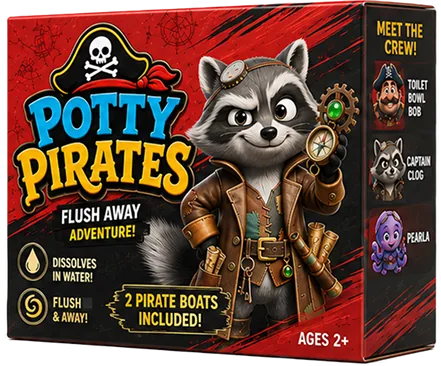
Captain Clog Edition
- A fleet of fizzing, color-changing pirate ships
- Aim-and-dissolve target practice in every bowl
- Non-toxic formula that cleans as it plays
- The whole collectible crew to discover
We'll email you the moment we launch on Kickstarter. No charge today.