
Potty Training an 18-Month-Old: Early Start, Realistic Expectations
Potty training an 18-month-old is possible, but readiness varies widely. What's realistic at this age, how to tell if your toddler's ready, and a gentle plan.
You’ve been thinking about potty training your 18-month-old, and you’re hearing mixed messages. Some say it’s too early. Others say it’s the sweet spot. The truth is somewhere in between: potty training an 18-month-old is possible, but it depends entirely on your child’s readiness, your bandwidth, and whether the process feels collaborative or like a daily battle.
This guide walks through what’s developmentally realistic at 18 months, how to tell if your toddler is ready, and a no-pressure plan you can start (or wait on) whenever it feels right.
Is 18 months too early to start potty training?
Not necessarily, but it’s earlier than average in the U.S. today.
According to the American Academy of Pediatrics, pediatricians typically discuss potty training at the 18-month wellness visit to set developmentally appropriate expectations, not because most children are ready to start training then. The average age potty training begins in the United States is between 2 and 3 years, and most children are fully trained by age 4.
That said, some 18-month-olds show clear signs of readiness. Historically, earlier training was common: in 1957, 92% of U.S. children were toilet trained by 18 months. Cultural norms have shifted, not developmental biology.
What matters more than age is whether your child can:
- Stay dry for two hours at a time
- Signal when they need to go (tugging pants, hopping, hiding)
- Walk to the potty and sit down
- Understand basic bathroom words like “pee,” “poop,” and “potty”
- Follow simple directions
If most of these milestones aren’t happening yet, waiting a few months often makes the process faster and less stressful for everyone. If they are, you have a window.
What’s different about potty training at 18 months
Potty training an 18-month-old isn’t the same as training a 2.5- or 3-year-old. Here’s what shifts.
Less verbal communication. Your toddler may not have the words to say “I need to pee.” You’ll rely more on observation: watching for cues, offering the potty on a schedule, and narrating what’s happening. This works, but it requires more parent involvement upfront.
Shorter attention span. Sitting on the potty for five minutes might feel like forever. Keep sessions short and playful. Sing a quick song, let them hold a favorite toy, or drop a fizzing pirate ship in the bowl to keep things interesting. (More on that in a moment.)
More reliance on routine. Eighteen-month-olds thrive on repetition. Offering the potty at the same times every day (after meals, before naps, after waking) builds the habit even before full bladder control kicks in.
Accidents are the norm, not the exception. At this age, your child may not recognize the urge to go until it’s already happening. Don’t expect independence. You’re teaching awareness first, control second.
How to tell if your 18-month-old is ready
Even if your child is 18 months old, readiness varies widely. Use this checklist to gauge where your toddler is:
Physical readiness:
- Can walk to the potty and sit down
- Stays dry for at least two hours during the day
- Has predictable bowel movements (fewer than three a day)
- Can pull pants up and down (or is learning to)
Cognitive and communication readiness:
- Understands what the toilet and potty chair are for
- Can follow simple one-step directions
- Knows words like “pee,” “poop,” and “potty”
- Signals when a diaper needs changing
Emotional readiness:
- Shows interest in the bathroom or watching you use the toilet
- Doesn’t resist diaper changes
- Seems curious about underwear or the potty chair
If your child checks most of these boxes, you’re in a good position to start. If not, it’s okay to introduce concepts now and launch the full process later. You can learn more about identifying readiness in our full potty training readiness checklist.
A realistic plan for potty training an 18-month-old
This isn’t a crash course. Think of it as a gradual handoff: you’re helping your child notice their body, connect the dots, and practice a new skill. Here’s a flexible framework.
Step 1: Introduce the vocabulary and the tools
Start using bathroom words consistently. Say “pee,” “poop,” and “potty” during diaper changes. Point out when your child is about to go: “I see you squatting. Poop is ready to come out!”
Bring in a potty chair. Place it wherever your child spends the most time (you can move it to the bathroom later). Let them sit on it fully clothed, decorate it with stickers, or pretend to potty train a stuffed animal. The goal is familiarity, not performance.
Model the process. Let your toddler see you or an older sibling use the toilet. Explain what’s happening in simple terms: “I’m sitting on the potty to pee.”
This phase can last days or weeks. There’s no rush.
Step 2: Offer regular potty sits
Once your child understands what the potty is for, start offering sits at predictable times:
- Right after waking up
- After meals or snacks
- Before and after naps
- Before bath or bedtime
- Anytime you notice a cue (squatting, dancing, tugging)
Keep sits short: two to five minutes max. If nothing happens, that’s fine. Praise the effort, not just the result. “You sat on the potty like a big kid!”
If your child resists sitting, don’t force it. Try again later or take a break for a few days. Our guide on toddlers who won’t sit on the potty has gentle strategies.
Step 3: Make it playful, not pressured
At 18 months, fun beats compliance every time. Turn potty time into something your toddler wants to do:
- Drop a fizzing pirate ship tablet in the toilet and let them watch it swirl and dissolve. (That’s where Potty Pirates comes in: aim at the ship, it fizzes and changes color, and the bowl gets clean while they’re learning.)
- Sing a potty song or read a short book together
- Let them flush (if they’re not scared of the sound)
- Celebrate every sit, whether or not they go
For more ideas, check out our list of potty training games toddlers beg to play.
Step 4: Gradually increase naked or underwear time
Diapers give no feedback. Your child can’t feel wet. Once your toddler is comfortable sitting on the potty, try short stretches without a diaper:
- Naked time in a safe, easy-to-clean space
- Training pants or underwear during awake hours at home
Accidents will happen. A lot. Stay calm. Say, “Oops, pee came out. Next time we’ll try the potty.” Clean up together without shame.
If accidents feel constant and your child seems confused or upset, it’s okay to pause and try again in a month or two.
Step 5: Be patient with the timeline
Some parents report success in a week. Others take months. Both are normal.
Boston Children’s Hospital notes that many toddlers complete daytime training in three to six months, but some need longer. Nighttime dryness often comes much later (sometimes not until age 5 or 6). For a deeper look at timelines, read how long does potty training really take.
Your job at 18 months isn’t to finish fast. It’s to help your child connect their body’s signals to the right action, over and over, until it clicks.
What if it’s not going well?
If you’ve been trying for a few weeks and your 18-month-old is melting down, refusing the potty, or having constant accidents, it’s okay to pause.
Potty training isn’t a test of your parenting or your child’s intelligence. Sometimes the timing just isn’t right. You can:
- Go back to diapers for a month or two
- Keep the potty visible but stop offering sits
- Focus on vocabulary and observation, not training
- Try again when your child shows more interest or control
You’ll find troubleshooting help in why potty training isn’t working and potty training power struggles.
When to choose a different approach
Not every family wants to start this early, and that’s completely fine.
Child-led potty training waits until your toddler initiates interest, usually closer to age 2 or 3. It’s lower-pressure and often faster once it begins. Learn more in our guide to child-led potty training.
The 3-day method works better with older toddlers (closer to 2.5 or 3) who have more bladder control and can communicate clearly. If you’re curious, read our honest step-by-step guide to the 3-day method.
You can also explore all the main approaches in potty training methods compared to find the one that fits your family.
Teaching boys to aim (when the time comes)
If you’re potty training a boy at 18 months, aiming probably isn’t top of mind yet. Most experts suggest starting seated for both pee and poop to keep things simple.
When you’re ready to introduce standing, turn aiming into a game. Drop a fizzing pirate-ship tablet in the bowl and let him aim at the target. The instant feedback (fizz, color swirl, dissolve) makes practice way more appealing than “aim at the water.”
Our full guide on how to teach a boy to aim in the toilet has more strategies for later.
Keeping the process screen-free and sensory-rich
At 18 months, your child learns best through touch, sound, and movement, not screens.
Potty training works when it engages the senses:
- The coolness of the potty seat
- The sound of pee hitting the water
- The fizz and swirl of a dissolving tablet
- The texture of toilet paper
- The rhythm of a potty song
Potty Pirates (those fizzing pirate-ship tablets) fit right into this sensory-rich approach. They’re not an app, not a digital reward system. Just drop one in, aim, watch it fizz and change color, and the bowl gets cleaned in the process. It’s play that has a point.
For more no-screen ideas, explore screen-free potty training activities.
A quick word on rewards
You don’t need sticker charts or candy to potty train an 18-month-old.
At this age, intrinsic motivation (curiosity, pride, playfulness) often works better than external rewards. Your toddler wants to feel capable, to explore their body, and to do what big kids do.
If you do want to celebrate progress, try:
- High-fives and cheers
- Letting them flush
- A special potty song or dance
- A fizzing pirate ship to aim at
If sticker charts appeal to you, that’s fine too. Just know they’re optional. Our post on reward systems that don’t lose their magic has more ideas.
What about regression or setbacks?
Even if your 18-month-old starts strong, regression is common. Illness, travel, a new sibling, or developmental leaps can all derail progress temporarily.
When accidents start happening again:
- Go back to more frequent potty offers
- Reassure your child (no punishment, no frustration)
- Lower your expectations for a week or two
- Keep the potty accessible and the routine consistent
For detailed help, read potty training regression: causes and how to fix it.
Your family’s readiness matters just as much
Potty training at 18 months asks a lot of you. You’ll need to:
- Watch for cues constantly
- Offer the potty many times a day
- Clean up accidents calmly
- Stay consistent across caregivers
- Accept that this may take weeks or months
If you’re not ready, that’s a valid reason to wait. Potty training works best when the whole household can commit to the routine without resentment. If you’re in the middle of a move, dealing with a new baby, or just exhausted, it’s okay to hold off until life feels steadier.
The big idea: Potty training an 18-month-old is possible if your child shows readiness and you have the bandwidth to stay consistent, patient, and playful. There’s no rush, and waiting a few months often makes the process smoother for everyone.
Sources
Frequently asked questions
Not necessarily. Some toddlers are ready at 18 months, while others won't be ready until 2 or 3. The American Academy of Pediatrics typically discusses potty training at the 18-month wellness visit to set expectations, but most children in the U.S. begin training between ages 2 and 3. Readiness depends on your child's physical, emotional, and communication skills, not the calendar.
Look for signs like staying dry for two hours at a time, signaling when they need to go (tugging pants, hopping, or hiding), and being able to walk to the potty and sit down. They should also understand basic bathroom words like 'pee' and 'potty,' and show interest when you explain what the toilet is for. If most of these aren't happening yet, waiting a few months often makes the process smoother.
There's no standard timeline. Some parents report success in a week or two with very young toddlers, while others find the process takes months. According to Boston Children's Hospital, many toddlers are potty trained in three to six months, but some need more or less time. Starting early doesn't guarantee finishing early, and accidents are normal for months (or even years) after daytime training begins.
You don't have to. Many experts suggest keeping it simple: praise, encouragement, and making the process fun without external motivators. If your 18-month-old isn't intrinsically motivated yet, adding rewards may not help and can complicate things. Focus instead on playful engagement, like turning aiming into a game with fizzing targets or celebrating effort, not just results.
Make potty training the part of the day they ask for
- A fleet of fizzing, color-changing pirate ships
- Aim-and-dissolve target practice in every bowl
- Non-toxic formula that cleans as it plays
- The whole collectible crew to discover
We'll email you the moment we launch on Kickstarter. No charge today.
Make potty training the adventure they ask for
Reserve your spot for early access and founding-crew pricing. No payment today.
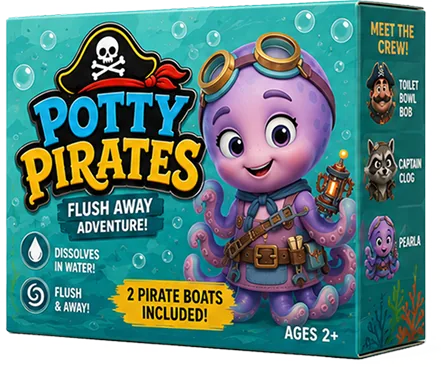
Pearla Edition
- A fleet of fizzing, color-changing pirate ships
- Aim-and-dissolve target practice in every bowl
- Non-toxic formula that cleans as it plays
- The whole collectible crew to discover
We'll email you the moment we launch on Kickstarter. No charge today.