
Potty Training a Child with Autism or Sensory Needs
Potty training an autistic child takes patience and adapted strategies. Learn concrete, judgment-free approaches that respect your child's unique timeline and sensory world.
Potty training an autistic child often follows a different timeline and requires adapted strategies. Many parents worry when their child turns four or five without interest in the toilet, but delayed toilet training is extremely common in autism and doesn’t reflect on your parenting. Understanding why this skill can be challenging and learning concrete adaptations can transform the process from overwhelming to manageable.
Why Potty Training Can Be Harder for Autistic Children
Toilet training intersects with many core features of autism. Children on the spectrum often learn new skills more slowly due to general developmental delays. They may struggle to break the long-established diaper routine, and there are relatively few daily opportunities to practice compared to other skills.
Communication challenges add layers of complexity. A child who is minimally verbal may not understand “Do you need to use the bathroom?” or know how to signal their need. Even nonverbal cues can be absent: many autistic children don’t show the typical “potty dance,” leg crossing, or grabbing that neurotypical kids display before an accident.
Sensory processing differences create real obstacles. The bathroom itself can feel overwhelming: cold toilet seats, bright lights, loud flushing sounds, rough toilet paper, and echoey tile rooms. Some children are under-responsive to the sensation of a full bladder or bowel, making it harder to recognize the urge in time.
Anxiety around toileting is common. Fear of the toilet, the flushing sound, or falling in can keep a child from even entering the bathroom. Medical issues like chronic constipation or diarrhea, which affect nearly 40% of autistic individuals, add physical discomfort to the emotional resistance.
Research shows that among 4- to 5-year-olds, 49% of autistic children are not yet toilet trained, compared with 24% of children with other developmental delays and just 8% of neurotypical children.
Signs Your Child May Be Ready
Don’t rush based on age alone. Look for these readiness indicators:
- Stays dry for at least 1-2 hours at a time
- Wakes up dry from naps
- Shows awareness of being wet or soiled (may hide, go to a corner, or seek privacy)
- Can follow one-step directions at least some of the time
- Shows any interest when others use the bathroom
- Has basic motor skills: can walk to the bathroom, pull pants up and down with help
If your child has significant communication delays, you may not see every sign. That’s okay. You can still begin with scheduled “clock training” or “timed sits” even if your child can’t yet tell you they need to go.
Many autistic children start showing readiness around age 3 or later. Waiting until your child demonstrates several of these signs typically leads to faster success than starting early out of pressure or comparison.
Creating a Sensory-Friendly Bathroom Environment
Address sensory barriers first. Small changes can make the bathroom feel less threatening:
- Use a padded or warmer toilet seat if cold porcelain bothers your child
- Adjust lighting: add a dimmer switch or nightlight if overhead lights are too bright
- Offer noise-canceling headphones or skip flushing while your child is still in the room
- Let your child choose softer toilet paper
- Add a sturdy step stool so feet are supported (this also helps muscles relax for bowel movements)
- Consider a potty seat with side supports if your child seems unsteady
If your child is comfortable, a small standalone potty can work, but many experts recommend starting with a toilet insert and stool. This saves the extra transition step later.
Using Visual Supports and Simple Language
When it comes to communication, less is more. Replace long explanations or questions with clear, direct language paired with visual cues.
Create a visual schedule showing each bathroom step in order: walking to bathroom, pulling down pants, sitting on toilet, using toilet paper, flushing (if tolerated), pulling up pants, washing hands. Use real photos of your child doing each step, or find simple picture cards online.
Instead of asking “Do you need to go potty now?” (which requires understanding and response), say “Time for potty” while showing the visual and immediately guiding your child to the bathroom.
If your child is nonverbal or minimally verbal, teach a simple way to request the bathroom: a sign, a picture card they can hand you, or a dedicated button. This builds communication skills alongside toilet training.
For children learning how to teach a boy to aim in the toilet, visual targets can be especially helpful once basic sitting and toileting are established.
The Clock Training Method
Clock training (also called scheduled sits or timed training) is the foundation for most autistic children. This approach doesn’t rely on your child recognizing their body’s signals or communicating the need.
Track patterns first. For 2-3 days, note when your child has wet or soiled diapers. Look for patterns: does your child typically go every 2 hours? Shortly after meals? First thing in the morning?
Set a schedule more frequent than accidents. If your child wets every 3 hours, start toilet sits every 2-2.5 hours. Use a timer or phone alarm as a neutral cue.
Teach sitting first, before expecting output. The initial goal is simply getting your child comfortable sitting on the toilet for increasing amounts of time (start with 10-30 seconds, build to 2-3 minutes). Use distraction: a favorite book, song, small toy, or video (just for toilet time). Don’t force sitting: guide gently and keep the mood calm.
Move to underwear as soon as active training begins. Modern pull-ups are too good at keeping skin dry. Your child needs to feel the wetness to make the connection. Yes, this means more laundry and accidents initially, but it significantly speeds learning.
Rewards That Work
Choose highly motivating rewards that your child only gets for toilet success. This could be:
- A special snack or drink
- A favorite toy or sensory item (kept out of reach otherwise)
- A preferred song or video
- A small grab-bag prize
- Calm praise plus a high-five or hug
Give the reward immediately when your child urinates or has a bowel movement in the toilet, not just for sitting. Pair it with simple, specific praise: “You peed in the potty!”
As your child becomes more successful, you can gradually fade the tangible rewards and rely more on social praise. For more ideas, see potty training reward ideas and potty training sticker chart alternatives if abstract charts don’t motivate your child.
Handling Accidents with Dignity
When accidents happen (and they will), minimize your reaction. No scolding, pleading, or lengthy discussions. Fussing can accidentally reinforce the accident behavior by giving it attention.
Use a calm, neutral tone: “You peed in your pants. Next time, pee goes in the potty.” Then complete cleanup with as little fanfare as possible.
Have your child help with cleanup in an age-appropriate, non-punitive way. If they’ve had a bowel movement in their underwear, they can help dump it in the toilet and flush it (if flushing isn’t a fear trigger). This teaches the routine without shame.
Save your attention and excitement for toilet successes, not accidents.
Addressing Constipation and Withholding
Constipation can derail toilet training. Hard, painful stools make children afraid to poop, which leads to withholding, which makes constipation worse.
If your child is having bowel movements less than three times per week, if stools are hard or painful, or if your child is clearly holding back, talk to your pediatrician before continuing toilet training. Treatment might include dietary changes, more water, or a gentle laxative.
Children who develop a fear of pooping may need extra support. Learn more in toddler holding poop and toddler refuses to poop in potty.
Building Motivation Gradually
Some autistic children show little interest in using the toilet. You can build motivation through:
Modeling: Let your child see trusted family members using the toilet (if they’re comfortable). Narrate what you’re doing in simple terms.
Special privileges: Frame toilet use as a “big kid” skill that unlocks new privileges like special underwear with favorite characters, or trying a new activity.
Making it a game: Once your child is sitting willingly, consider adding a visual element to the bowl. Potty Pirates, fizzing, color-swirling pirate-ship tablets you drop in the toilet, can turn aim practice into a game for boys learning to stand. The immediate sensory feedback (fizz, color change, dissolving) can be motivating for kids who respond well to cause-and-effect play, and they’re screen-free, which keeps focus on the task. Other toilet targets for potty training include floating targets, flushable targets, or even Cheerios.
For more engagement ideas, see how to make potty training fun and potty training games for toddlers.
When to Pause and Regroup
If you’ve been actively training for 3-4 weeks without any progress, or if your child is showing increased anxiety, aggression, or regression in other areas, it’s okay to pause.
Take a break for 4-6 weeks. Go back to diapers or pull-ups without comment or disappointment. When you restart, your child may be developmentally more ready.
Other reasons to pause:
- Major life changes (new sibling, move, change in caregivers)
- Illness or developmental regression
- Unresolved medical issues like constipation
- Extreme fear or resistance that feels traumatic
There’s no award for earliest completion. For older children still in diapers, see 5-year-old not potty trained for perspective and guidance.
Working with School or Therapists
Consistency across environments helps. Share your toilet training plan with your child’s school, daycare, or therapists. Provide them with:
- Your visual schedule
- The specific language or signs you’re using
- Timing of scheduled sits
- Preferred rewards
- Any sensory accommodations
Many children make faster progress when the same approach is used at home and school. If your child attends daycare, read potty training and daycare for coordination strategies.
Nighttime and Daytime Are Separate Skills
Focus on daytime dryness first. Nighttime dryness is controlled by different developmental mechanisms (bladder capacity, hormones that reduce nighttime urine production, ability to wake when bladder is full).
Most children with autism need several more months to years to achieve nighttime dryness after daytime success. Nighttime accidents aren’t within a child’s conscious control and shouldn’t be treated as failures.
Continue nighttime pull-ups or waterproof mattress protection until your child wakes dry most mornings for several weeks. For more on this distinct skill, see nighttime potty training.
When to Seek Additional Support
Talk to your pediatrician or developmental specialist if:
- Your child is over 4 and showing no signs of readiness
- Toilet training attempts consistently lead to extreme distress, aggression, or self-injury
- You suspect chronic constipation, diarrhea, or other GI issues
- Your child is regressing after previous success
- You’re feeling overwhelmed and need professional guidance
Occupational therapists can address sensory issues and motor challenges. Behavior analysts (BCBAs) can design individualized toilet training programs. You don’t have to do this alone.
A Final Word on Timelines and Comparison
Every autistic child’s toilet training journey looks different. Some are trained by 3.5, others not until 5, 6, or older. Delayed toilet training doesn’t predict long-term outcomes. Your child will get there.
Progress isn’t always linear. You may see weeks of success followed by a regression. Illness, stress, developmental leaps, or changes in routine can all cause temporary setbacks. That’s normal, not failure.
You know your child best. Trust your instincts about when to push gently, when to pause, and when to ask for help. This skill, like all others, will happen on your child’s timeline, not a chart’s.
The big idea: Potty training an autistic child requires patience, sensory adaptations, visual supports, and a scheduled approach that doesn’t rely on your child recognizing or communicating the urge. Progress may be slower and non-linear, but with respect for your child’s unique needs and timeline, success will come.
Sources
Frequently asked questions
Children with autism often experience developmental delays, communication challenges, resistance to routine changes, and sensory sensitivities that can extend the potty training timeline. Research shows autistic children typically complete toilet training around 3.3 years on average, compared to 2.5-3 years for neurotypical children. Medical factors like constipation or diarrhea, which are more common in autism, can also slow progress.
Look for readiness signs rather than a specific age: staying dry for 1-2 hours, following simple directions some of the time, and showing interest in the bathroom. Many autistic children aren't ready until age 3 or older, and that's completely okay. Starting before your child shows readiness can lead to frustration for everyone.
Experts recommend transitioning to underwear as soon as possible during active training. Modern pull-ups can be too effective at wicking moisture away, preventing your child from connecting the feeling of wetness with needing to use the toilet. The sensory feedback from wet underwear is an important part of learning, even though it means more laundry initially.
Choose highly motivating rewards your child only gets for toilet success, like a favorite toy, special snack, song, or sensory item. Visual supports matter too: use picture schedules showing each bathroom step, and consider a simple visual reward system rather than abstract sticker charts. Immediate rewards paired with calm praise work better than delayed or social-only rewards.
Make potty training the part of the day they ask for
- A fleet of fizzing, color-changing pirate ships
- Aim-and-dissolve target practice in every bowl
- Non-toxic formula that cleans as it plays
- The whole collectible crew to discover
We'll email you the moment we launch on Kickstarter. No charge today.
Make potty training the adventure they ask for
Reserve your spot for early access and founding-crew pricing. No payment today.
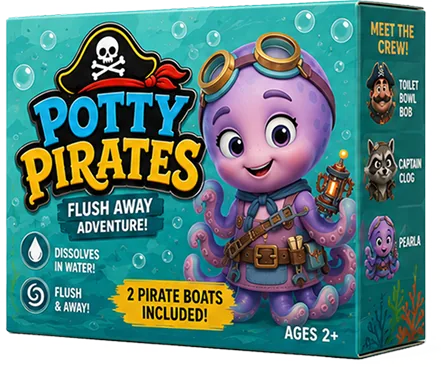
Pearla Edition
- A fleet of fizzing, color-changing pirate ships
- Aim-and-dissolve target practice in every bowl
- Non-toxic formula that cleans as it plays
- The whole collectible crew to discover
We'll email you the moment we launch on Kickstarter. No charge today.