
5-Year-Old Not Potty Trained? Why It's Often Okay (and What to Do)
Your 5-year-old isn't potty trained yet. Before you panic, read this. Most late trainers catch up without intervention, and pressure usually backfires.
If your 5-year-old is not potty trained, you’re likely toggling between worry, frustration, and exhaustion. You’ve probably tried sticker charts, rewards, timers, books, songs, and maybe even bribery. You’ve watched younger siblings or cousins master it in days while your child remains unfazed. And you’ve probably heard “Don’t worry, they won’t go to college in diapers,” which, while true, doesn’t help much right now.
Here’s what does help: understanding why some kids train late, what’s developmentally realistic at this age, and how to move forward without shame or pressure.
Why some children train later (and why that’s often okay)
Most children in the United States are bowel and bladder trained by age 4, according to the American Academy of Pediatrics. But “most” doesn’t mean “all.” A meaningful percentage of children take longer, and the reasons vary widely.
Developmental readiness isn’t just physical. Potty training requires a complex blend of physical control, cognitive understanding, emotional regulation, and internal motivation. Some children simply aren’t ready at the “average” age, even if they’re meeting other milestones on time.
Pressure often backfires. The more stressed or anxious a child feels about toileting, the more likely they are to resist. This can create a cycle where well-meaning adults push harder, and the child digs in deeper.
Toilet training is not a measure of intelligence or stubbornness. Late training doesn’t predict school readiness, behavior issues, or future success. It’s a developmental task, like learning to ride a bike or tie shoes, and kids get there on different timelines.
Medical or sensory issues can play a role. Some children have undiagnosed constipation, sensory processing differences, or developmental delays that make toilet training genuinely harder. If you suspect something beyond typical resistance, talk to your pediatrician.
What’s different about training a 5-year-old
At 5, your child is no longer a toddler. They understand cause and effect. They can follow multi-step instructions. They likely have strong opinions and a fierce need for autonomy. All of this changes the approach.
Drop the toddler tactics. Sticker charts, songs, and cutesy rewards may feel babyish to a 5-year-old. If your child resists, it might be because the method feels condescending, not because they’re being difficult.
Language matters more now. Your child can articulate fears, preferences, and discomfort. Ask open-ended questions: “What feels hard about using the toilet?” “What would make it easier?” Listen without judgment.
Autonomy is non-negotiable. At this age, power struggles are common. The more you control the process, the more your child may resist. Shifting to a child-led approach can reduce conflict and hand ownership back to your child.
Social awareness kicks in. Many 5-year-olds start to notice that peers use the toilet. This can be motivating, but it can also trigger shame. Handle peer comparisons gently and never use them as ammunition.
Common reasons a 5-year-old isn’t potty trained yet
Fear or anxiety
Some children are genuinely scared of the toilet: the noise, the size, the sensation of elimination, or even the idea of something leaving their body. This isn’t defiance. It’s real fear.
If your child shows signs of anxiety, slow down. Let them explore the bathroom at their own pace. Offer a small potty chair instead of the big toilet. Read books about toileting without any pressure to perform. See our guide on helping a toddler who’s afraid of the toilet for more strategies.
Constipation or withholding
Chronic constipation can make toilet training painful, and pain creates avoidance. If your child is holding stool, having hard or infrequent bowel movements, or crying during elimination, constipation may be the culprit.
Talk to your pediatrician. Treating the constipation first is often necessary before training can progress. Our article on toddler holding poop offers more detail.
Sensory sensitivities
Some children have heightened sensory awareness and find the feeling of wetness, the texture of underwear, or the sensation of sitting on a toilet overwhelming. This is especially common in children with sensory processing differences or autism spectrum traits.
If this sounds like your child, consider sensory-friendly modifications: soft toilet seats, a step stool for stability, or even allowing them to wear familiar clothing during attempts.
Power struggles and control
Toileting is one of the few things a child can fully control. If other areas of their life feel restrictive or chaotic, they may cling to this autonomy fiercely.
The antidote? Remove yourself from the power struggle. Stop reminding, cajoling, or rewarding. Make it clear that toileting is their job, and you trust them to handle it when they’re ready. Our post on ending potty training power struggles offers a dignity-first framework.
Lack of internal motivation
Some kids just aren’t bothered by wet or soiled pull-ups. If there’s no discomfort and no internal drive to change, external rewards rarely create lasting motivation.
In these cases, switching to underwear (so they can feel wetness) or waiting until they express readiness themselves can be more effective than pushing.
Developmental or medical concerns
In rare cases, late toilet training signals an underlying issue: developmental delays, urinary tract abnormalities, or neurological conditions. If your child has other delays, frequent UTIs, or signs of pain, consult your pediatrician.
A calm, practical plan for moving forward
Step 1: Pause and reset
If you’ve been in a battle for months, take a break. Announce to your child (calmly, without frustration) that you’re taking the pressure off. Tell them you know they’ll use the toilet when they’re ready, and you trust them.
This break can last a few weeks. Use the time to observe without intervening. Notice when your child shows signs of needing to go, what times of day accidents happen, and whether any patterns emerge.
Step 2: Rule out medical issues
Schedule a check-in with your pediatrician. Discuss:
- Bowel movement frequency and consistency
- Any pain or fear around elimination
- Urination patterns
- Developmental milestones in other areas
Your doctor can assess for constipation, urinary issues, or developmental concerns and offer guidance tailored to your child.
Step 3: Make the bathroom inviting (not babyish)
Let your child choose a new toilet seat, step stool, or even bathroom decor. Give them ownership over the space. Avoid cutesy toddler items unless your child picks them.
If your child is a boy, consider making aiming a game. Toilet targets like Potty Pirates, fizzing pirate-ship tablets that turn the bowl into a color-swirling treasure hunt, can make the act of aiming feel fun and rewarding without any pressure. Learn more in our guide on how to teach a boy to aim in the toilet.
Step 4: Shift language and expectations
Stop talking about “big kid” behavior or comparisons to peers. Instead, frame toileting as a skill your child is learning, just like reading or riding a bike.
Use neutral, factual language: “Bodies make pee and poop. Toilets are where we put them.” Avoid shame, frustration, or urgency in your tone.
Step 5: Let your child lead
Offer opportunities without pressure. “The bathroom’s available if you need it.” “Let me know if you want to try the toilet today.”
If your child refuses, let it go. If they agree, celebrate the attempt (not just the result). “You listened to your body and tried. That’s the skill.”
Step 6: Address accidents without shame
Accidents will happen. A lot. Respond calmly: “You had an accident. Let’s clean up together.” No yelling, no consequences, no disappointed sighs.
If accidents are daily and your child shows no awareness or concern, it might be worth revisiting the pull-ups versus underwear question. Some children need to feel wetness to build awareness. Others need the security of pull-ups to reduce stress. Choose what works for your family, and don’t let guilt drive the decision.
Step 7: Explore what motivates your child
Forget candy and stickers if they’re not working. At 5, motivation might look like:
- Choosing their own underwear with favorite characters
- Earning screen time or a special activity after successful attempts
- Having a say in family decisions (“You get to pick dinner tonight because you used the toilet”)
- Using the toilet as a step toward a desired milestone, like starting kindergarten or a sleepover
See our post on potty training reward ideas for alternatives that work better than candy.
Step 8: Consider outside support
If progress stalls or your child’s resistance feels entrenched, ask your pediatrician about:
- Occupational therapy (especially for sensory issues)
- Behavioral therapy or counseling (for anxiety or control issues)
- A pediatric urologist or gastroenterologist (for medical concerns)
You don’t have to do this alone.
What if my child starts kindergarten not potty trained?
Many schools require children to be potty trained for enrollment. If your child’s 5th birthday is approaching and training isn’t complete, talk to the school early.
Some schools offer flexibility or support for children with documented delays. Others are firm. Knowing the policy ahead of time lets you plan, whether that means intensifying efforts, seeking medical evaluation, or exploring alternative school options.
The intersection of fun and function
Making toileting less clinical and more playful can lower resistance. For boys especially, adding an element of aim and instant feedback can shift the experience from “chore” to “game.”
That’s where tools like Potty Pirates come in. These small, pirate-ship-shaped tablets dissolve in the toilet bowl when you aim at them. They fizz, swirl with color, and disappear, turning every trip to the bathroom into a mini adventure. They’re screen-free, non-toxic, biodegradable, and clean the bowl as they dissolve. No apps, no treasure maps, just simple, immediate fun that rewards aiming without any lectures.
If your 5-year-old has been resistant, a low-pressure tool that makes the toilet feel less like a battleground and more like a place where something cool happens can be the shift you need. Learn more about the science behind this kind of engagement in our post on color-changing potty tablets.
When to worry (and when not to)
Don’t worry if: your child is healthy, meeting other milestones, and simply taking longer to train. Late training alone, without other red flags, usually resolves.
Do talk to your doctor if:
- Your child has frequent pain or distress around toileting
- Bowel movements are hard, infrequent, or painful
- Your child has frequent UTIs or urinary accidents after being dry for months
- You see signs of developmental delays in other areas
- Training has stalled completely for six months or more despite your best efforts
Why pressure doesn’t work (and what does)
Toilet training is one of the first major areas where a child’s autonomy and a parent’s expectations collide. You can’t force a child to use the toilet. You can only create the conditions that make success more likely.
Pressure creates resistance. Shame, comparison, frustration, and urgency all backfire. Children sense your stress and mirror it.
Calm creates capacity. When you step back, breathe, and trust the process, your child has space to step forward.
If you’re stuck in a power struggle, our article on potty training a stubborn toddler offers dignity-first strategies that work at any age.
You’re not failing
If your 5-year-old is not potty trained, it doesn’t mean you did something wrong. It doesn’t mean your child is behind, broken, or difficult. It means they’re on a longer timeline, and that’s okay.
Every child is different. Some train at 18 months. Some train at 5. The finish line is the same for everyone, and there are no prizes for getting there first.
Your job isn’t to force or fix. It’s to support, observe, and trust that your child will get there when they’re truly ready.
The big idea: A 5-year-old who isn’t potty trained yet isn’t broken or defiant, they’re on a longer timeline, and pressure almost always backfires. The best plan? Pause, rule out medical issues, remove the power struggle, and let your child lead.
Sources
Frequently asked questions
It's not typical, but it's not rare either. Most children in the U.S. complete toilet training by age 4, but some take longer for developmental, emotional, or medical reasons. If your child is otherwise healthy and meeting other milestones, late training often resolves without medical intervention.
Common reasons include developmental delays, sensory sensitivities, anxiety or fear around the toilet, power struggles, constipation or withholding, and simply not being emotionally ready. Sometimes a child is physically capable but lacks the internal motivation or feels pressured, which can stall progress.
Talk to your pediatrician if your child shows signs of pain or fear around toileting, chronic constipation, frequent accidents with no progress over several months, or if you suspect a developmental or medical issue. Your doctor can rule out physical causes and refer you to specialists if needed.
There's no single right answer. Some experts recommend underwear to help children feel wetness and build awareness, while others suggest pull-ups reduce stress for both parent and child. The key is consistency and removing any shame or punishment around accidents, whichever route you choose.
Make potty training the part of the day they ask for
- A fleet of fizzing, color-changing pirate ships
- Aim-and-dissolve target practice in every bowl
- Non-toxic formula that cleans as it plays
- The whole collectible crew to discover
We'll email you the moment we launch on Kickstarter. No charge today.
Make potty training the adventure they ask for
Reserve your spot for early access and founding-crew pricing. No payment today.
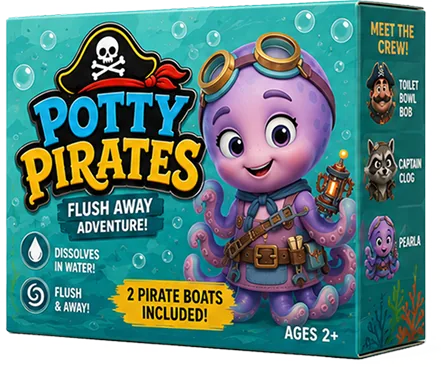
Pearla Edition
- A fleet of fizzing, color-changing pirate ships
- Aim-and-dissolve target practice in every bowl
- Non-toxic formula that cleans as it plays
- The whole collectible crew to discover
We'll email you the moment we launch on Kickstarter. No charge today.